
If you’ve been following all of the Don’t Worry Darling press tour drama or lightly misogynistic backlash to the film, then you probably heard from those same sources that the film is a trainwreck. I’m here to report (to some disappointment I’m sure) that Darling is not. Is it the genre-bending, feminist, awards season player we hoped for? Not even close. It falls more into the mediocre middle-ground, and if the film wasn’t so darn pretty and Florence Pugh so darn good, then it would probably be forgotten to the B-movie schlock genre it belongs to.
Don’t Worry Darling tells the story of Alice (Pugh) a young newly-wed 1950’s housewife who lives with her husband Jack (Harry Styles) in the experimental town of Victory. A place where the women stay home, while the men all go to work at a mysterious company out in the desert under the direction of the cult-like leader Frank (Chris Pine.) Alice spends her days cooking, cleaning, shopping, and taking dance lessons with the ladies. A life so planned out and mundane that she starts to question the mysterious company and finds out just how deep her community’s rabbit hole goes.
I won’t go into spoilers in this review, but things are not as they seem. Director Olivia Wilde described the film as being like Inception, The Truman Show, and The Matrix.This is true in that all the main characters of those films have characters that are struggling with their reality, but the comparisons stop there. Those films are well-written and follow a gradual arc, Darling is poorly plotted to the point that pacing feels both too slow and rushed at the end.
A lot of this falls on Wilde’s go-to screenwriter Katie Silberman who takes sole screenplay credit, and falls into so many writing pitfalls it will make your head spin. The rest falls on Wilde, who lacks the experience as a director to take on a project like this. She and Silberman made the wonderful Booksmart back in 2019 and they took on too much with this project. Wilde needed her smaller budget second film before attempting something like this or she should have directed something with less creative control.
The director and the screenwriter struggle to tell a cohesive or urgent story. Most of the 2nd act is spent on shocking imagery that lacks subtext or meaning, almost as if the images were thought of first and then shoehorned in. The scenes go by one by one with Alice starting to lose her mind and while they have the shock factor the scenes fail to push the main narrative forward and we’re left with a film that’s spinning its wheels for almost half the run time. Then when mysteries finally are revealed and questions are answered long after we lost interest the film scrambles to make up for the lost time.
The last act moves so fast that it’s hard to keep track of anything, there are car chases and big reveals that don’t add up. When the truth comes out you’re sucked right out of the narrative because when even a small amount of thought is applied to the late twists they fall apart. The film wants to be bigger than the sum of its parts and to be important. Instead, Wilde creates the film equivalent of the obnoxious hipster who can name social issues all day but lacks any compelling reasons as to why they are important.
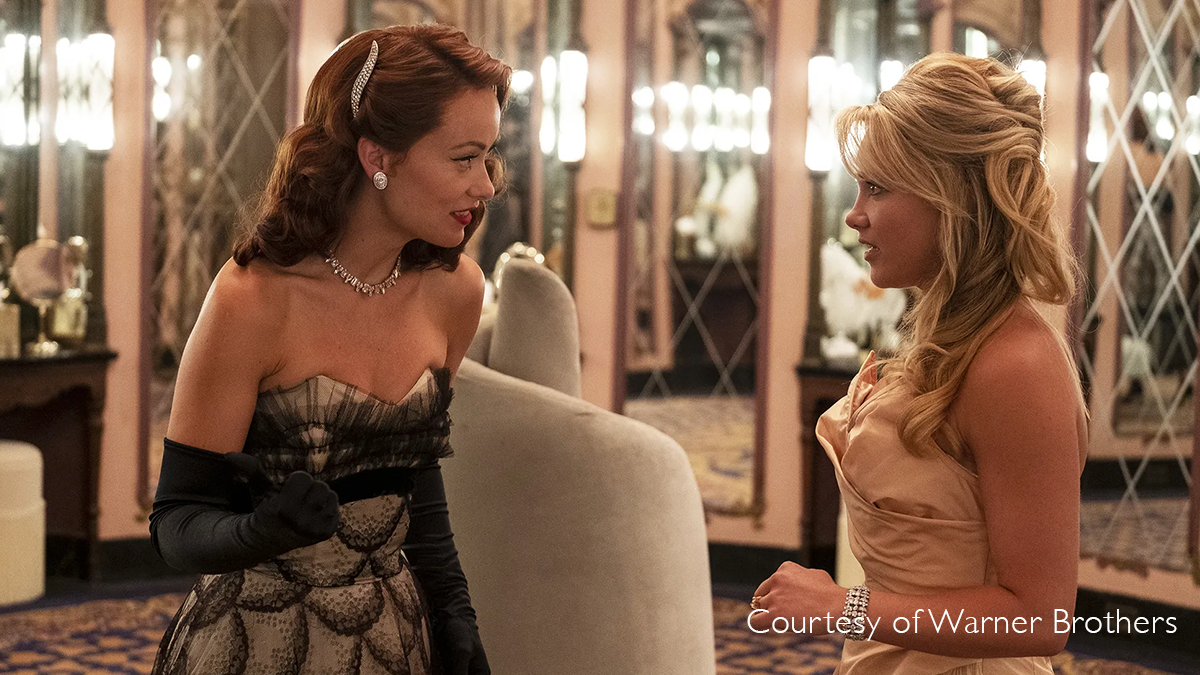
It’s a shame because Darling falls apart so easily when it has so much still going for it. Director of Photography Matthew Libatique paints vivid, colorful images of a 1950’s utopia, letting the amazing costumes and beautiful production design fill his frames. The town of Victory is so well realized as a set piece that I hope they save it for a better movie. The town is full of life, with popping colors, shiny cars, and gorgeous landscapes.
Still, the strongest part of Darling is the great Florence Pugh. She has a way of turning any pencil-thin character sketch into a fully realized character. In lesser hands, Alice would have been a completely forgettable character but Pugh is able to fully embody the underdeveloped character and give her life. She’s in an entirely different class of film than most everyone around her. With the exception of Chris Pine who also delivers a stellar performance. His good looks and natural charm create unease when paired with his cult-like leadership status and he commands every scene he is in. When Pine and Pugh go head to head sparks fly and the film comes alive, it’s too bad Wilde didn’t realize this. The less is said of Harry Styles’s uneven performance the better. At least he gives it the old college try.
Don’t Worry Darling is a film that wants to be groundbreaking, and so desperately say something important and be a lightning-in-a-bottle phenom that it forgets to be a decent movie. The message is the end is both muddled and predictable, leaving us with a film that’s all style over substance. Much like the town of Victory, Don’t Worry Darling is pretty to look at it but look too closely and you’ll see nothing but the cracks.
2.5/5
Don’t Worry Darling
Directed by Olivia Wilde
Screenplay by Katie Silberman
Starring Florence Pugh, Harry Styles, Olivia Wilde, and Chris Pine
In Theaters Everywhere September 23rd